Create
any number of Set Lists with any number of songs.
Auto-scroll
songs in the editor as you play them.
Print
songbooks with guitar chord diagrams.
Important Notice
I have changed the license of the ChordSmith program and software to the GPLv3. That makes the program and its source code available to all. I have set up a ChordSmith project page on SourceForge. As a consequence, I will discontinue this website in June, 2024. Until then, both websites are functional. The website at SourceForge
is very similar to this website, and in the future, when the ChordSmith
program detects that a new version is available, it will take you to SourceForge to download the update. I suggest you bookmark the new website.
ChordSmith is
a Giftware program
that can transpose song sheets containing chords and lyrics
from one key to any other.It can also edit and convert song sheet
formats
(including Harmonica tabs) between ChordPro format (chords in square brackets in line with lyrics) and two-line format
(chords above
lyrics). You can find many
free sources of song sheets in both formats on the Internet. Some
sources
of song sheets are listed at the
end of this document. Here are just a few of ChordSmith's many features:
ChordSmith
will convert songs among different musical notation systems: Letter
names (A through G), Nashville numbers (1 through 7), and solfège names
(Do, Re, Mi...).
ChordSmith also lets you
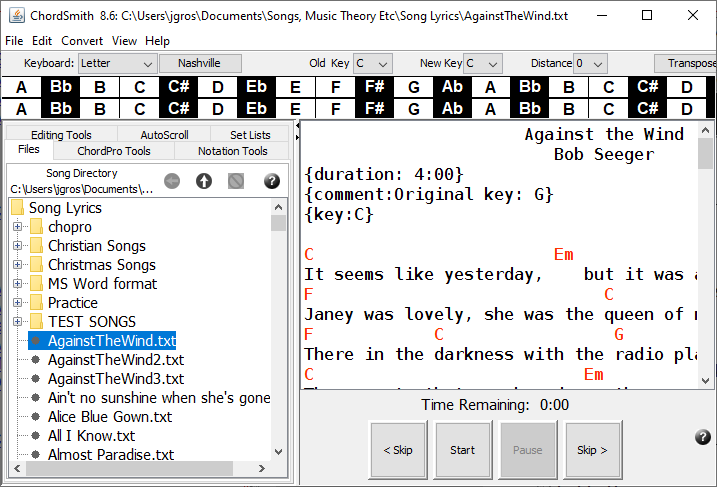
create any number of named set lists. Each set list can have any number of songs. It has an autoscroll feature that
scrolls the song on your screen while you play it.
ChordSmith can transpose the key of any song instantly.
ChordSmith can batch-convert hundreds of songs to or from ChordPro format in seconds.
ChordSmith has powerful
editing features that allow you to move chords with one click. You can
also copy just the chord lines from one verse and paste them all into
another verse with one click.
ChordSmith comes with a tailored open-source application, Chord, which can be
launched by ChordSmith
and which, among many other features, allows you to view and print
songs and songbooks with high
quality and optionally with guitar chord symbols.
ChordSmith
is written in the Java programming language and will run on any
operating system that has Java 1.7 or higher installed. It runs in
Microsoft Windows,
Macintosh OS and Linux.
Note: This site may
contain affiliate links. That means that if you click on them and buy
anything at all, I'll get a small commission from the sale (at no
additional cost to you). For more information, read my disclosure.
Who
can use ChordSmith?
If you play a chordal instrument such as guitar, piano, etc., and you
play "by ear" based on chords from song
sheets, you can use ChordSmith
to transpose your chords into any key you prefer.
If you use an app, such as OnSong,Chordinator,
SongBookor Setlist Helper
on your iPad or Android tablet, which requires its input to be in
ChordPro format, you can use ChordSmith
to convert your song sheets from two-line format to ChordPro. If you
already have a large number of songs in two-line format, you can use ChordSmith's
batch feature
to convert hundreds of files in seconds to ChordPro (or the reverse).
What
is a song sheet?
A
song sheet is a text file that has the chords and lyrics of a song.
Sometimes they are called "fake sheets" or "lead sheets". There
are three styles of song sheets that are most common on the Web:
"Two-line" style, ChordPro style, and "Rise Up" style. A fourth kind of
song sheet is the Harmonica tab sheet, which uses numbers instead of
chord names to indicate which hole to play on the harmonica.
Two
Line Style Song
Sheets
The first style, which for want of a better name I call "two-line"
style, is
easiest
for humans to read. In two-line style, the chords are above the words
where the chord changes are to be made. It looks like this:
 D               C      D7      Em               A
Once she came in-to my room, feathered hat, and all,
Here
is the result of transposing the above two-line example
from the
key of D to the key of F#:
 F#              E      F#7     Abm              C#
Once she came in-to my room, feathered hat, and all,
ChordPro
Style Song
Sheets
The
second song sheet style is called "ChordPro" and was developed to
be easy for a machine to read. Software exists (for example, Chord and
Songsheet
Generator) to convert ChordPro
text into HTML or PostScript. The ChordPro format has the chords embedded in the
lyrics using square brackets as delimiters. Here is a ChordPro
equivalent to the above:
O[D]nce she came in-[C]to my r[D7]oom, fea[Em]thered hat, and a[A]ll,
And
here is the transposed version:
O[F#]nce she came in-[E]to my r[F#7]oom, fea[Abm]thered hat, and a[C#]ll,
ChordSmith can
convert files from two-line format to ChordPro and the
reverse. The
files must be text-only files without tabs--no HTML, no Word files,
etc. ChordSmith
doesn't
know how to handle the formatting features of those files. But see
below in the section "What if my
song sheets are not in pure text files".
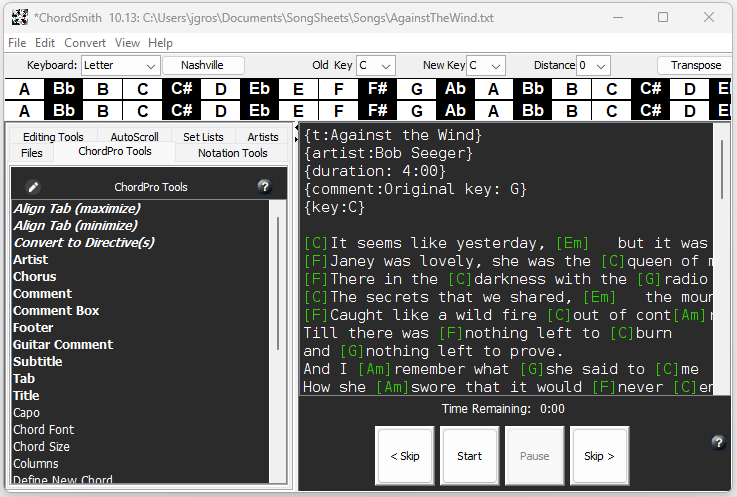
The following figure shows a song in the ChordPro format. The figure also shows ChordSmith in its "Dark Background" mode with a different color choice for the chord names.
Rise
Up Style Song
Sheets
The
third style, popularized by Rise
Up Singing: The Group Singing Songbook, is
designed to minimize space by putting the chords for an entire verse on
a single line following the verse like this:
A long, long time ago
I can still remember how that music used to make me smile
And I knew if I had my chance
That I could make those people dance
And maybe they'd be happy for a while

/ GD Em / Am7 C Em D / GD Em / Am7 C / Em Am D /
The
above example was borrowed from http://www.guntheranderson.com/v/charts.htm,
which describes the format in detail. ChordSmith
cannot convert this format (which I will refer to as
"rise-up" format) to or from ChordPro or two-line formats, but
it can transpose it from one key to another.
Harmonica
Tab Song Sheets
Harmonica players use a two-line format to describe how to play a song
using the harmonica. The first line of a pair has numbers representing
which hole to use and other characters to represent whether to blow,or
draw, or bend the note. Since these notations do not represent note
names or chords, ChordSmith
cannot transpose them between keys but it
can convert them to and from ChordPro format.
There
are
two main harmonica tab notation schemes. The more prevalent one uses
numbers to represent hole position on the harmonica and a minus sign to
represent drawing a breath, no sign to represent blowing. It has a few
other conventions the details of which you can find at http://en.wikipedia.org/wiki/Tablature#Harmonica_tablature.
The second main notation scheme uses numbers for the harmonica hole
positions followed by a "B" for "Blow" and "D" for Draw. You can find
details for this method at http://www.harmonicainstruction.com/songs_marylamb.shtml.
4-4   5    6   6-6  6  5
 I  came from Al-a-bam-a
 4  -4  5  5  -4  4  -4
with my ban-jo on my knee;
Chord Notation Systems
There are a number of different notation systems in use to designate which chords to use in a song. ChordSmith handles three major systems, Letter Notation, Nashville Notation, and Sofège Notation. These are described next.
Letter Notation
The
letter naming system uses the capital letters A through G to name the
notes of the octave. To indicate the half-steps above and below the
named note it uses the "#" for a sharp note and the lower case B, "b",
for a flat note. ChordSmith allows
you to convert between Letter notation and the other notations
(Nashville notation and solfège notation).
Nashville
notation
The
Nashville Numbering System (NNS) is a method of using the numbers 1
through 7 instead
of names to designate the chords of a song. The advantage of the
Nashville Numbering System is that you can play a song in any key
without changing your song sheet. It requires
that you know what the
chords are in each key for the given numbers. Using numbers means that
a
song sheet is valid in any key as long as you remember the
corresponences between the numbers and the chords of whatever key the
song is to be played in. ChordSmith
allows you to convert between Nashville notation and the other
notations (Letter notation and solfège notation).
Solfège Notation
Some countries prefer to use the names DO, RE, ME... instead of letters
to name their notes and chords. This is called "solfège"
notation. ChordSmith
can convert among solfège, Nashville and Letter names. It can also
convert between two-line and ChordPro format for all three notations.
Here is an example in two-line format, where Do represents the C chord:
Do            Fa                           Sol Sol Fa
Where is the moment when we need it the most
Do                  Fa                     Sol Sol Fa
You kick up the leaves and the magic is lost
ChordSmith
allows you to change the solfège names if the defaults are not to your
liking. You define your preferred names in a text file in the ChordSmith folder.
See the ChordSmith
Help file after installation for instructions.
Where
can I find song sheets?
You can enter your own chords and lyrics into Chordsmith to
create your own song sheets, but you
can also find song sheets for thousands of songs on the internet. One
way is
to do a Google, Yahoo or Bing search for the name of the song you are
interested in, enclosed in quotes, followed by the search words "chords
lyrics", like this:
"You've got a friend" chords lyrics
Here are a
few
websites that provide free song sheets:
OODocBatchConverter
is another program I wrote that can help you convert a bunch of files
from one format, say DOC or RTF, to another format, say TXT. (It won't
convert from PDF to TXT.) The program uses
the free Apache
OpenOffice
program to do the conversions. It can do any conversion that
Apache OpenOffice can perform because it uses Apache OpenOffice to do
the
actual conversion. Without OODocBatchConverter you would have to
convert the files one at a time. Apache OpenOffice is an excellent
office
suite that includes a word processer (Writer), a spreadsheet (Calc), a
presentation program (Impress), a drawing program (Draw), and a
database program (Base), all for no cost.
After conversion to pure text format you will probably have to edit
most of the chords to position them properly over the lyrics. That's
because most people use tabs to position the chords in the DOC, DOCX,
or RTF formats and the tabs need to be replaced by unpredictable
numbers of spaces in the pure text format.
What
is Giftware?
ChordSmith a
giftware
program. I have enjoyed creating and maintaining it as a hobby
and I give it to you in hopes that you will enjoy using it. It is my
gift to you. If you use it and like it, you might feel
moved to
make a gift to me.
If so, you can do so with the PayPal
links below, with complete
security. Any amount
will make me happy. If you decide to make a gift, you will be helping
me pay for the maintenance of the program and this website. If you
decide not to donate money, maybe
you'd like to send
me a note about your
experiences with ChordSmith
(hopefully
good, but if not good, I need to know that too). I will
consider your
note a gift, for it is an investment of your time and interest.
NOTE:
After downloading, if double-clicking does not launch the installer,
then your machine
probably does not have Java installed. Click on the "Java Download"
button
below to
download and install the Java Runtime Environment. Mac users can get the latest
Java for
Mac at this URL: http://www.java.com/en/download/faq/java_mac.xml. Mac users who want Java 1.6 can get it
fromhttp://support.apple.com/kb/DL1572.
If
you have trouble installing ChordSmith:
Mac Users:
Upgrading
your
Mac operating system to OS X 10.9 probably removed Java from your
system. If the installer won't start by double-clicking it, or the
ChordSmith.jar file won't start by double-clicking it, then you
probably do not have Java installed on your system. You can get Java
1.7 for Mac here:http://www.java.com/en/download/faq/java_mac.xml.
You can get Java
version 1.6 from this link: http://support.apple.com/kb/DL1572.
If you
have Mountain
Lion or OS X Lion v10.7.5
and you get a warning that the OS won't open the program (either the
installer or the ChordSmith.jar file itself) because it was
created by an "Unidentified
Developer", then go to http://support.apple.com/kb/ht5290
and scroll down to the heading “How to open an app from
a unidentified developer and exempt it from Gatekeeper”.
Follow those instructions. Those instructions will override the
Gatekeeper only for the program you choose (ChordSmith) and not affect
any other program.
Windows users: If
Java is installed but double-clicking on the installChordSmith.jar file
(or any other *.jar file) doesn't launch the installer (or
other
*.jar file), then your PATH variable is probably not set. Go here
to find out how to set it.
Windows users,
please note: IF YOUR OS WON'T LET THE
INSTALLER INSTALL THE PROGRAM, then do one of the following:
Download
the zip file instead of the
installer and extract the zip file into your "C:\users\public" folder,
OR
using the
installer:
Start
the Chordsmith
Installer by double-clicking on the
file
"installChordSmith.jar" that you downloaded from this web page.
Step
through the installer until you get to where it asks
you
"Select the installation path:".
Click
the "Browse..." button and navigate to the
"C:\Users\Public" folder on
your desktop.
Add
"\ChordSmith" to the folder name so it becomes:
"C:\Users\Public\ChordSmith"
Select
that folder and click the "Next" button.
Proceed
until the installer completes the installation.
If
you want a shortcut to ChordSmith
on your desktop, find the
"ChordSmith.jar" file inside the "Chordsmith" folder. Create a
shortcut by right-clicking on the file and selecting "Create shortcut".
Move the shortcut to your desktop.
Linux users, please
read the following:
The easiest way to install ChordSmith
is to download the zip version of the file and unzip it . Then set the
permissions on the "ChordSmith.jar" file to "Executable".
You can make a link to it an put the link on your desktop.
Double-clicking the executable jar file or the link file should start
the program.
To use the ChordSmith
installer under Linux:
Download the installer from the website. It should work with Linux if
you have Java properly installed. Don't
let your Archive program try to extract files from it.
Set the permissions on the installChordSmith.jar file to allow
execution. You might have to run the installer in a command terminal
like this:
cd <directory containing the installer>
java -jar installChordSmith.jar
Make sure you install the program into a directory in which you have
full permissions.
You might need to set the execute permission on the installed ChordSmith.jar
file.
Once the program is installed, it must be run such that its working
directory is the directory containing the ChordSmith.jar
file. So, probably the easiest thing to do is to create a command file
containing commands similar to the following two, perhaps named
"launchChordSmith":
cd <directory containing the ChordSmith.jar file>
java -jar ChordSmith.jar
Then, whenever you want to launch the program, just invoke the command
file.
Removed Foxtrot library and all
references to it because it invokes proprietary and deprecated Oracle
APIs. Replaced it with SwingWorker.
Added count of Artists to the Artists tab.
Added an "Abort" button to the Artists tab.
Allowed popup menu on Artists list (the upper list) in Artists tab. The menu was only available in the lower panel before.
Added "Find Song(s) containing a phrase..." feature to the Artists tab's popup menu.
Changes for Version 10.13
Corrected Tip of the Day presentation file (TipOfTheDay.txt)
that in Linux would not display some of the images. The problem was
that linux is picky about the case of filenames and I wasn't. Problem
doesn't show up in Windows and Mac because they are indifferent to
filename case.
Fixed bug in Find/Replace where it failed when target contained a character, such as '[' that is a special character in a regex.
Changed
the "Check for update" logic so that if it can't find my website, it
will lead the user to the SourceForge website to request to be notified
about updates.
Other minor bug fixes.
Changes for Version 10.12
Revised to allow users to enter special characters commonly used
in chord names, such as ♯♭°øΔ in place of #b dim,m7b5,Maj. This
required extensive revisions to ChordSmith as well as to Chord5. Before
you use these symbols, make sure your app can process and display them
correctly.
Changed the Find/Replace dialog so that the "Replace All" button
can be limited to do replacements in chords only, lyrics only, or both.
Added an "Artists" panel that automatically scans your default
song folder and its subfolders, if any, and builds a "database" of Artists and all their songs. This can be saved as a CSV file.
Changed SetList title label and popup menu to a ComboBox so that
the feature would be visible to user. With the popup menu, the user was
unlikely to find the feature without careful reading of the help doc.
Changed auto-markup to mark a song's second line as {artist:..} instead of subtitle, {st: ...} or {subtitle:...}.
Fixed bug of missing chordpro tools definition files.
Changed dark background color to (43, 43, 43).
Improved the help browser in both ChordSmith and Chord5 so it doesn't lose its place if the user changes the window size.
Changes for Version 10.11
Updated Chord5 program used by ChordSmith.
Removed installer panel "create shortcuts" for desktop shortcuts because it didn't work.
Made ChordSmith window icon to appear in the MacOS dock.
Changed "Check for update" so that it opens user's browser to
SourceForge ChordSmith project if it can't access the ChordSmith
website.
Fixed link to Chord5 help doc in the ChordSmith Help file.
Added to the copy/paste chords feature. Originally, this feature
only operated in two-line mode. I added a hyphenation dictionary
(thanks are due to Matthew Hindson) and algorithms that make copy/paste
chords work in ChordPro format also.
Added a popup menu to Set List title bar to switch directly to a differen Set List.
Fixed bug in function that identifies the Operating System that the program is running in.
Changes for Version 10.00
Updated "about" box to include 2022 for copyright, and added notice of the GPLv3 license.
Lengthened the ToolTip timeout to 15 seconds.
Changed code to make ChordSmith abort after warning if it gets a "can't find Tip of Day file".
Changed to GPLv3 license and put project on SourceForge.
Changed name of jar file from ChordSmith_INTL.jar to ChordSmith.jar
Changes for Version 9.00
Added a button, "Insert", to the Scroll Panel to create a
{Duration } directive and add it to the current song. This helps to
make changing the song duration easier.
Added ability to display file path of any song in a Song List by
holding down Shift key while hovering mouse over the song name in the
list. Added a Tip of the Day describing this feature.
Moved menu item "Send to Chord App" to bottom of File menu and changed name to "Print Using Chord App..."
Changed text of menu item (in File tab popup menu) "Send Selected
Song(s) to Chord App" to "View/Print Selected Songs via Chord App".
Made corresponding changes to text and figures in Help and Tip of the
Day.
Changes for Version 8.9
Now allows user to choose where to store their Set Lists. This
allows you to store them in the cloud (e.g., DropBox) for access via
multiple devices.
Corrected transposition algorithms to better conform chord and note names to music theory.
Added "Ctrl+[" keyboard shortcut to help add chords in chordpro
format. It enters both brackets and puts the cursor between them.
"Ctrl+Shift+[" does same for "{..}". Works on Mac too (using Ctrl, not
Command)
Changed NNS keyboard (in the SlideRule) to include both sharps and flats. (originally had only flats).
Corrected tooltip on title of the Notation Tools panel.
Made "File not found" error message in set list panel (due to renamed or moved song file) more clear.
BUGFIX: Fixed bug in current "To ChordPro" conversion, which
confused "st" ("subtitle" abbrev) with "start_of_tab", and confused
"t", "ts", "tf" and "tempo".
BUGFIX: The Transpose and the Solfege button's algorithms would
affect chord names within a {sot}...{eot} marker. Contents of the
bracket are supposed to be literal and never to be changed by the
program. Now they will not be affected.
BUGFIX: Tab templates were distorted by conversion from 2-line to chordpro.
BUGFIX: Font size on Tip Of The Day did not update when Edit>Select Font Size menu was used.
Changes for Version 8.8
Added a "tip of the day" feature to highlight the less visible features of ChordSmith.
Changed rules for annotation lines so they include "NC", "N.C.", "nc", and "n.c.", meaning "NO CHORDS".
Added colorization for harmonica tab lines.
Replaced Java icon in ChordSmith windows with the ChordSmith circular slide rule logo. (Only works in Windows.)
Some minor bug fixes.
Changes for Version 8.7
Fixed bug in Undo/Redo.
Changed title of Preferences>Editor>Dark Colors checkbox to "Dark Background".
Changes for Version 8.6
Now allows user to select the color in which the chord names are
displayed in the editor. The color is chosen using the
Preferences>Editor tab>Chord Color button.
Fixed rare bug where the OnSong ChordPro tool set was not copied to the user's preferences directory.
Changes for Version 8.5
Added an "Editing Tools" tab panel. It duplicates much of the
Edit menu to provide more convenience for multiple edits in a song file.
Added a menu item "Edit>Remove Trailing Blanks". It works on a
selection only. To apply to the whole song, just use "Edit>Select
all".
Changed "Dark" background color to black instead of dark blue.
Changed menu items "Convert>To/From ChordPro Abbreviations" to
work on a selection if there is a selection or on the whole song if no
selection. Before, they always did the whole song.
Changed wording of menu items "Edit>Extend Lines with Blanks"
to "Edit>Add Trailing Blanks to Selection. Also made it able to add
blanks multiple times.
Fixed bug where adding songs to a setlist via the "+" button failed to save the new song(s) into the list.
Fixed similar bug for removing a song from setlist.
Fixed similar bug for adding song(s) from files panel popup menu.
Fixed other minor bugs and corrected some tooltip texts.
Changes for Version 8.4
Added
an alternative set of ChordPro tools that implements the directives
used by the OnSong app. If you use OnSong and want to install the
OnSong tools, go to the Edit>Preferences>Tools. Click on the
"Choose Backup File..." button. From the file dialog that appears
select the file "ChordProToolsOnSong.txt". Relaunch ChordSmith and the
OnSong tools will be found on the ChordPro Tools tab.
Added display of ChordPro tool tooltip to Preview in the "Create New ChordPro Tool" Preview dialog.
Added an HTML line editor to help format tooltip text for user-defined ChordPro tools.
Allowed commas in tooltips created
by ChordSmith's "Create New ChordPro tool" wizard. Before, the first
comma in a tooltip would terminate the tooltip (because the Tools file
is a CSV file).
On touchscreens, the Skip
buttons on the autoscroll panels can be made to skip repetitively by
touching the left or right Skip button in the center and sliding toward
the outside of the button.
Bug Fix: Mac Big Sur OS would not
display the Preferences menu item in the screen's menu bar. Now on Big
Sur, Preferences displays in the Edit menu. On earlier Mac OSs, it will
still now display in two places: on the main menu bar and the Edit menu.
Changes for Version 8.3
Added feature to the autoscroll
panels so that as long as user long-clicks the left or right "Skip>"
buttons, the 10 sec skip will be done repeatedly. This does not work
for the touch screen long-presses.
Minor updates to ChordSmith Help file.
Added "Getting Started" menu item to Help menu.
Changes for Version 8.2
Added ability to copy or move selected songs between set lists using the Set List panel's popup menu.
Made the help button (at the right
of the Transpose button) on the EditPanel context-sensitive. Now, if a
chord is marked for Moving or Copying (with a green highlight), the
help button will bring up the help text describing "Repositioning Chord
Names". Otherwise, it will bring up the help text for "Transposition
Tool Bar".
Changes for Version 8.1
Bug Fix: Certain key
transpositions would produce unnecessary double-sharp or double-flat chords.
Corrected the transposer so it would produce the simpler enharmonic
name, e.g., "Abb" would be changed to "G".
Changes for Version 8.0
Added menu item "Add Selected
Song(s) to Set List" to the Files popup menu. Allows user to select
some songs in the Files list, then add them to the end of one of the
existing set lists.
Updated a few tooltips.
Minor corrections to the Help file.
Changes for Version 7.9
Added ability to handle slash chords in all notations (letter, nashville and solfege).
Fixed bug that caused the lower slide rule to move to wrong location when clicked.
Changes for version 7.8
Added a menu item "Send Selected List(s) to Chord App" to the Set List panel popup menu.
BUGFIX: Fixed error in "Check for Update" feature that caused it to fail.
NOTICE:
Version 7.6.1 had a bug that disabled the "Check for Update" feature,
so if you have that version you won't be notified of newer versions.
Make sure you download the latest version by clicking on the link above.
Changes for version 7.7
Changed Preferences>Editor tab
to allow using any system language in the editor. You should only use
this if your language is not accommodated by ChordSmith's default set
of fonts. If you use it, make sure that you choose fonts that are
"mohospaced", i.e., every character, including space is of the same
width.
Changed name of prefs file from
".ChordSmithPreferences" to "ChordSmithPreferences" so it won't be a
hidden file on Unix type systems.
Changed "Edit>Replace Tabs with
Spaces" menu item to work on a selection if there is one, or the entire
file if there is no selection. Before it only worked on the entire
file.
Improved detection of path to jar
file: Made paths to resources (such as Fonts.zip) not depend on the
user's working directory so that the jar file can be started from any
directory in a console window.
Now allows launch of the Chord app (menu selection File>Send to Chord App or Ctrl+G) without needing a song to be in the editor.
Fixed Keyboard slide rule, which
was unresponsive to clicks where the mouse wasn't held perfectly still
(slight mouse drags), so it now responds to mouse release as well.
BUGFIX: Added a timeout to the "Check for Update" feature in case the website is inaccessible for any reason.
Changes for version 7.6.1
BUGFIX: fixed
bug that caused chord lines with single chord to not be converted to
chordpro.
BUGFIX: When
song was in chordpro
format and prefs were set to NOT mark up the title/subtitle, the
title/subtitle would still be marked up when changing music notation
(NNS<->Solfege<->Letter).
Changes for version 7.6
Added View>Show/Hide Scroll
Controls menu item.
Added View>Scroll From
Editor/Set List menu option to toggle the smaller
autoscroll panel to be at the bottom of the editor window or the Set
List window.
Preferences:
Added checkbox to chose whether to display/hide autoscroll controls
(Doesn't affect the AutoScroll Tab).
BUGFIX: If song
was in Chopro
format and there were some non-chord text lines following the {title:
...} and/or {subtitle: ...} directives, and a redundant command was
given to convert to Chopro format, then the plain text lines would be
removed.
Changes for version 7.5
Added button to
the Song List title bar to open the selected song in the editor window.
Added a button
to the Song List title bar to move the selection to the next song and
open it.
Added "Send
Selected Song(s) to Chord App" item to the "Files" and "Song List"
popup menus.
Added
"Enter/Exit TouchScreen
mode" button to Edit Panel to allow users to make List and Tree list
multi-selections without using the Ctrl key. This makes it easier to
select multiple songs on a touch screen.
Changed popup
menus' text in Set List mgr to Title Case.
Made some
organizational edits and corrections in the Help file.
BUGFIX: Fixed
bug that wouldn't recognize 11th chords, eg., "G11".
BUGFIX:
Transposing a song in ChordPro format caused the Title and Subtitle
directives to be removed.
BUGFIX: If a
chordpro file had
title and/or subtitle directives but those were followed by plain text
line(s), the trailing line(s) would also be automatically be converted
to directives {title:... and/or {subtitle:...
Changes for version 7.4:
Added
scrollpane controls (<Skip, Start/Stop, Pause/Resume,
Skip>) to the Song List panel.
Added "Open
SetList" button to Set List panel.
Added "Open
Song" button to Song List panel.
Added "View"
menu. Moved Show/Hide
keyboard, Show/Hide Tools, and Dark Editor ("Light/Dark Background)
menu items from the Edit menus to the View menu.
Added "Time
Remaining" indicator To panels that control scrolling.
Changes for version 7.3:
Added display of song lengths and set lengths. These are
computed
based on ChordPro {duration: mm:ss} commands that the user inserts in
songs.
Added a button (pencil edit icon) to the ChordPro tools
panel to
allow user direct access to the wizard for creating and deleting
ChordPro commands from the tools list.
Some minor changes to button icons.
Added scrollpane to the Notation Tools panel and the
AutoScroll panel.
Changes for version 7.2:
Allowed "mi" as a valid substitute for "m" or
"min" as a chord variation abbreviation for "minor" per user
request.
On AutoScroll tab:
Added forward and backward Skip buttons.
Changed size of AutoScroll buttons to make them easier to
use on a touch-screen.
Changed the Song Length box to accept decimal or mm:ss
time format.
Changed Refresh button so it copies the time from the
{duration: mm:ss} directive as-is, i.e., "mm:ss", instead of converting
it to decimal time.
Clarified some tooltips.
Revised the Help doc for above changes and corrected some
formatting problems.
Changes for version 7.1:
SongListPanel:
Changed tooltip and confirm dialog to say "Remove" song instead of
"Delete" song from set.
Added the
Iosevka-light.ttf font to the fonts.zip file
Made setlist
mgr and song lists respond to Enter key.
Added popup
menus to the Setlist manager and Song lists.
Updated the PDF
version of the Help file.
Updated
copyright date to 2018 everywhere.
Changes for version 7.0:
Added Set List
Manager.
Changed "Song
List" tab name to "Files".
Changed
"Preferred Chord Names" to "Familiar Chord Names".
Moved all
ChordSmith support files to be in their own
<user.home>/ChordSmith folder.
Added a
"File>Select Songs for Book" menu item to the
CHORD program to help in making song books.
Fixed some bugs.
Changes for version 6.0:
Changed the
transposing algorithm
adding the option to use chord names that are appropriate to a song's
key (consistent with music theory) instead of just the more common
chord names that were on the program's keyboard slide rule.
Changed the
keyboard slide rules to handle either the chord names that ChordSmith has used
in the past or the full set of music theory chord names. Choose between
these in Preferences>Editor tab.
Added a
checkbox to the
Preferences>Editor tab to allow the user to choose whether to
use
the limited set of chord names ("Preferred" names) or the
key-appropriate set of names. ChordSmith
defaults to the limited set for compatibility with earlier versions.
Added "What's
new..." item to Help menu. It opens your browser to this location.
Cleaned up the
Dark Editor interface.
Fixed some
bugs.
Changes for
version 5.6:
Revised Song
Directory panel,
ChordPro Tools panel, and other panels to change their foreground and
background colors along with the Editor's colors under control of the
Edit>Dark Editor (F7) menu item.
Adjusted the
display of the folder
icons in the Song Directory poanel so that they don't overlap each
other for small font sizes.
Added
acceptance of double sharp
and double flat enharmonic equivalents. (Converts them to the basic
non-double equivalents that are shown on the Keyboard slide rule.)
Changes for version 5.5:
Added a
"Preview" button to the ChordPro Tool Wizard so user can see how the
command will look when used..
Swapped the
Cancel and OK buttons
in the Define New Tool and the Delete Tools wizards to conform to the
other dialogs in the Preferences dialog.
When closing
the Preferences dialog, now destroys the ChordPro Tool Wizard window.
Keep
Preferences/Tools from creating multiple Wizard Create and Delete
Dialogs.
Changes for version 5.4:
Lengthened
tooltip delay from 100 ms to 500 ms on the ChordPro tools tab.
Added "Artist"
and "Capo" tools to the ChordPro Tools list.
Changed name of
"Reformat Tab" tool to "Align tab".
Changed name of
"Format Directive(s)" tool to "Convert to Directive(s)"
Changed
ChordPro tool tab to read its tool descriptions from a file so users
can add their own tools.
Added an "Add
Tool" wizard and a "Delete Tool(s)" wizard to allow the user to edit
the ChordPro tools list.
Changes for version 5.3:
Added
"Help>Download Manuals (PDF)" menu item to download PDF files
for both manuals (ChordSmith
and Chord).
BUGFIX: Chord program
Help>Help locked up the program and did not open the help doc.
Changes for version 5.2:
Changed both
ChordSmith and Chord to make them compatible with Java version 9.
Changes for version 5.1:
Changes to
ChordSmith:
Added
{duration: mm:ss} directive to ChordPro tools panel.
Added
functionality to set the song length in the AutoScroller automatically
from the
{duration:....}
directive in a song.
Added
"Refresh" button to AutoScroll panel to update the AutoScroll Song
Length when the {duration...} directive is added or changed by the user.
Added "User
Forum" item to Help menu.
Changes to
Chord:
Made user
Options persistent between executions of Chord.
Added a
"Defaults" button to the Options panel.
Options panel
now allows multi-line Copyright text. Copyright text is saved between
executions of Chord.
Bugfix:
Changed Chord program so it won't give error messages for unrecognized
ChordPro commands. It will ignore them.
Changes for version 5.0:
Added
to the ChordPro tools the ability to insert full ChordPro command names
instead of just their abbreviations. Choice is made via
Edit>Preferences>Tools tab.
Added
ChordPro command abbrev/fullname converter and batch file converter via
Convert menu. Converts ChordPro commands from their abbreviations to
their full names or the reverse.
Added version
number to title of "Help>Check for update..." dialog box.
Finally got the
scroll timing to be exact.
Bug FIxes:
Caret was
invisible on dark editors because it was black. Changed it to white on
dark and black on white.
When
font is changed in preferences after a chopro markup (or other change)
but before saving, the text reverts to the original unmarked-up file
without warning when the OK button is clicked on Preferences dialog.
Now it will warn user.
"Copy
Chords" (Alt-click) would move highlight to lower position (left, by
the width of the chord) when chord was pasted at the end of a line that
was at an earlier position (lower line number) than the highlight.
Changes for version 4.9:
Added
preference to allow user to specify default file extensions for chopro
and two-line files. Allows no extension, "". On Mac made the "Attach
menus to Mac menu bar" checkbox enable the "Apply" and "Revert" buttons
when changed.
Updated
copyright dates on About box.
Changes to
CHORD co-program:
Removed the
unimplemented "Number logical pages, not physical" checkbox from the
options panel.
Added ability
to independently enable/disable printing of the footer line, page
number, and title from the Options panel.
BugFix: when
^G (Go To Page #) text box was empty and OK or Cancel was chosen, it
gave a "Invalid Numerical Value" alert.
Bugfix: "Even
page number on left" option did not work.
Rearranged
the remaining checkboxes on the options panel.
BugFix:
locally defined chord grids would display a solid circle atop open
strings. Changed that to draw an open circle.
Bugfix: "No
grids for easy chords" option did not work.
Changes for version 4.8:
Added an
auto-scroll panel to the tools pane. Ctrl-Period ("Ctrl-.") toggles between Start scrolling and
Stop scrolling. Ctrl-Comma ("Ctrl-,") toggles between scroll Pause and
scroll Resume.
Added
ability to toggle the editor between "night colors" (white letters on
dark background) and normal colors (black text on white background)
using the F7 key or the "Edit>Dark Editor" menu item.
Changes for version 4.7:
Changed
some menu locations on Mac installation to better conform to Mac user
interface standards:
Moved "About", "Preferences" and "Quit" menu items from the
File, Edit and Help menus to the Main program menu (next to the Apple
menu),
"ChordSmith>About", "ChordSmith>Preferences" and
"ChordSmith>Quit".
Made similar
menu changes to CHORD, the
companion program.
Fixed minor
bugs in CHORD that affect both Mac and
Windows operation.
Now
allows Mac user to choose between attaching
application
menubar to the standard Mac position at top of screen or to the Windows
standard position at the top of the application main window. The
reason for this option is that there is a bug in the Java/Mac GUI code
that inhibits menu items on the standard Mac menu bar from changing the
visibility of their state. See the topic "Note for Mac Users" in the
"Preferences" section of the ChordSmith>Help document for more
details.
Changes for version 4.6:
Added to Song
List directory tree:
The ability
to respond to Enter key by opening a selected file or folder into the
editor.
Alt-Page
Up/Down: moves selection to previous/next song and opens it in the
editor.
Changed comment
delimiter in solfege.txt file from "#" to "!" ("#" is still allowed).
Bug fix: Now
includes the solfegeNamesExample.txt file in the installer download.
Changed
installer default location to "C:\Users\Public" for Windows and
"Applications" for Mac.
Changes for version 4.5:
Added the
handling of solfège (DO, RE, ME...) names with either fixed DO or
Moveable DO.
Allows user to
change the default solfège names to their preference using a solfegeNames.txt
file.
Added
conversion between solfège and either Letter chord names or Nashville
numbers.
Any ChordSmith
feature that applies to Letter names and Nashville numbers also applies
to solfège Names.
Added a
Notation Tools tab to the editor's left hand panel. This allows
notation conversions with a single click.
Added a solfège
keyboard.
Changed default
"Old Key" and "New Key" settings to "C" (instead of "A") for
convenience of those using the solfège conversions.
Now can use the
Ctrl-Click on the Nashville button to convert to solfège.
Added "drag and
drop" to Batch Converter dialog box.
ChordSmith now
automatically converts a non-ChordPro song to ChordPro as is required
when sending it to the Chord App.
Changes for version 4.0:
Included a
modified version of the open source program, Chord, to
allow you to see how your songs will look with their chordPro
directives. Chord
will also beautifully print songs and song books.
Added menu item
"File>Send to Chord App" (Ctrl/Command-G) so ChordSmith can send
a song in chordPro format to Chord
to be reviewed and printed.
Added webpages
to website to allow users to download the modified Chord distribution.
Added several
directive tools to the ChordPro tool list.
Alphabetized
the two tool lists.
Added newline
at end of all directive templates (lower list).
Changes for version 3.85:
Updated
interface to work better on the Mac:
All Mac menu
shortcuts now use the command key instead of
the Ctrl key.
Some keyboard
shortcuts that didn't work on the Mac have
been corrected.
Minor bug fix.
Changes for version 3.80:
Added ChordPro
tool "Reformat Tab (minimize)".
Added warning
when a chordpro tool that requires a
selection is clicked and there is no selection.
Improved
behavior of annotation lines. Now allows lines
including "|" and "/" for markup.
Improved
identification of chord names by reducing false
positives.
Changed "key"
chordpro tool to use "key" instead of the
abbreviation, "k".
Can now specify
a song file path to be opened
when launching ChordSmith
from command line.
Changes for version 3.70:
Made the song
list put the tree nodes in alphabetical order
based on the user's Locale.
Added Ctrl+R
accelerator code to the Edit>Replace
Tabs with Spaces menu item.
Corrected some
dead URL links in the Help file.
Changed
names of Tab Template Chordpro tools, eliminating their numbers (e.g.,
"Tab Template 2") to make them more descriptive. (e.g., "Tab Template
(Labeled)").
Added icons to
some Help menu items.
Added "Top"
button to the Help browser.
Improved Chord
name validation algorithm to minimize
anomalous cases.
Changes for version 3.69:
Fixed failure
to open browser on MacOS.
Added
"Indent Selection" (right and left shift) items to "Edit" menu. They
add or remove a space at the beginning of each line of a selection.
Changed the
color of the "move chord" highlight from blue
to green. Its blue was too close to the selection highlight color.
Fixed other
minor bugs.
Changes for version 3.68:
Added "alt" to
legal variations on chord names.
Added Print
Preview menu item to File menu.
Changes for version 3.67:
Added a Search
field and button to the Help Browser.
Added a
"Replace All" button to the Find dialog.
Made editor
replace all non-breaking spaces (hex A0) with
normal breaking spaces (hex 20).
Added tool to
ChordPro tools list to "Format Directive(s)".
Changed
File>Save so that if the file has no
extension, Save will not add one unless it is a chopro version.
Changes for version 3.66:
Added
ability to apply transposition to a selection within a song to allow
user to "modulate" the key. This was a user suggestion.
Fixed
several functions (transposeText, convertToChordPro,
convertFromChordPro, breakColonLines) in class TextTransposer so that
they don't add a newline at the end of their output text if the input
text didn't have one.
Changes for version 3.65:
Disabled Edit
and popup menu items that affect selections
when there is no selection.
Changed
"Edit->remove chordpro Directives from Selection" so it removes
the
markups but leaves the text for the commands Title, subtitle, comment,
guitar comment, and footer. It still removes markup and text for all
other directives. It works for multi-line directives also. E.g., if
Title is two lines.
Added Copy
Chords/Paste Chords menu items to edit menus.
Improved
conversion of multiline title and subtitle directives between ChordPro
and 2-Line style. If there are multiline title and/or subtitle
directives, they are left alone: they are not stripped out when
converting to 2-line.
ChordPro tools
that require a selection
now will do nothing if there is no selection. They used to insert a
directive with a "null" at the cursor.
In
BatchConvertFiles
dialog, changed the tooltips of the "Select Input Files" and "Select
Output Folder" labels so that after input and output are selected, the
tooltips show the whole path to each. Before, for a long path there was
no way to see what it was.
Changes for version 3.64:
Added an
"autosave" feature to save a song being edited to
a
recovery file periodically to avoid loss of work. The Autosave time
interval can be set by the user in Preferences.
Moved "Apply"
button from the "Editor" tab to the bottom of
the Preferences dialog box.
Added small
"Help" button to the transposition toolbar.
Added "Current
Encoding" label to the Preferences Encoding
tab.
Rearranged the
ChordPro Tools list.
Changes for version 3.63:
Added "Change
Text Encoding" feature.
Added "Don't
ask again" checkbox to the popup dialog that
asks if user wants to download new version.
Preferences
Help button now jumps to the help for the
selected tab.
Added help
buttons to ChordPro Tools tab and Song List tab.
Made all the
help buttons jump to the place in the help
text that discusses the feature on which the help button is placed.
Added a
"Tutorials" selection to the Help menu.
Changes for version 3.62:
Added ability
to convert Harmonica Tabs to and from
ChordPro format.
Added
Shift-click to "Transpose" button to perform the
reverse transposion.
Added a splash
screen.
Allowed
Ctrl+Alt as "copy chords"
key. This is to accommodate Linux (Ubuntu), which preempts the Alt key
in the editor. Alt by itself still does the job in other operating
systems.
Fixed bug: the
"copy and move
chords" feature couldn't place a chord at the end of the song if there
was not an newline character there..
Fixed bug: Made
Old Key dropdown menu move the Nashville
keyboard to proper
position when the Old Key selection is changed. It used to not move the
Nashville keyboard.
Changes for version 3.61:
Fixed bug that
sometimes prevented selecting an output
folder in the "Batch Convert" dialog.
Changes for version 3.60:
Added
conversion between Nashville Numbering System and
standard chord notation.
Added Nashville
"keyboard".
fixed some
minor bugs.
Changes for version 3.50:
Added
"Open/Expand/Collapse" menu item and "Expand All", "Collapse All", "Set
as root" and "Up one level" menu items to the Song Directory popup
menu.
Added "Back",
"Up one Level" and "Cancel" buttons to the
Song Directory title panel.
Added optional
automatic markup to subtitle line in
addition to the title line.
Added "Show
tools on startup" checkbox to Preferences Tools
tab.
Changes for version 3.40:
Added two
ukelele tab templates to the ChordPro tools
panel.
Added cut,
copy, and paste to Song List Panel's popup menu
items.
Made Song List
panel group all folders together at
beginning of each level's list, before the list of files.
Added
multi-noncontiguous-selection capability to the Song
List panel.
Other minor
user interface changes.
Changes for version 3.30:
Added a panel
to display the contents of a user-chosen song
folder.
Combined the
song folder panel with the ChordPro tools in a
resizable tabbed panel.
Added
a menu item, "Edit>Extend Chord Lines with blanks" to help with
repositioning or adding chord names to the end of a line.
Added
a "Tools" tab to the Preferences Dialog to control the font size of the
tools (ChordPro commands panel and Song folder tree) separately from
that of the editor.
In the File
open/save/save-as dialogs and
the batch convert dialog, the chopro filter now allows several
different common chordPro extensions, eg., chopro, cpro, chp, etc.
When opening a
new file in the editor, it now scrolls to
the top instead of the bottom.
Changes for version 3.20:
Added a set of
tools to markup a song with ChordPro codes.
(Access from Edit>Show
ChordPro Tools menu item.)
Fixed
bug in conversion from chordpro of "{t:song title}" where it would
treat any line starting with "{t" as if it were a title. That caused it
to misinterpret other tags that started with t.
Changes for version 3.10:
Fixed the
problem of program failure on the Mac. Many
thanks to Al McPhee for his aid in troubleshooting the problem.
When
converting to ChordPro, now by default the program assumes that the
first non-blank line is the title and rewrites it in chordpro format
as: {t: myTitle}. When converting back from ChordPro to 2-line, removes
the chordPro formatting and left justifies the title.
Added a
checkbox to the Preferences>General tab to
enable/disable the ChordPro title markup.
Fixed operation
of the Preferences Revert button.
Revised the
program so that now it needn't be started from
its home directory, but may be started from any directory.
Added .txt and
.chopro filters to the Batch Convert "Input
Files" dialog and the Open Files dialog.
Changes for version 3.00:
Added a
"Preferences" panel to set the default song
directory and the preferred font and font size.
Added an
"Edit>Select All" menu item.
Made Batch
Convert dialog input and output file selection
buttons start browsing from the current default song folder.
Made
three items in the Edit menu maintain the selection after they are
completed so they can be applied in succession without reselecting:
Remove Chords From Selection, Remove Blank Lines From Selection, Insert
Blank Lines into Selection.
Rearranged
order of same three menus.
Changed font of
the Help file from Times to Helvetica.